The Suit That Improves with Time
How to care for a bespoke tailoring piece so it lasts for decades — and why the philosophy of interfering less is the most honest principle of preservation.
The suit you wear today can accompany you for decades. But, like everything made by hand, it asks something in return: attention — and the understanding that caring well begins with interfering less.
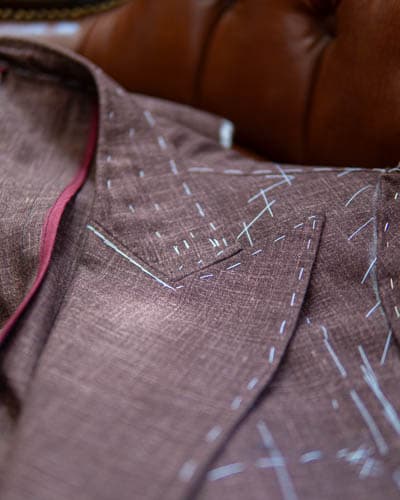
There is a moment, just after the final fitting, when the client puts on the jacket for the first time and notices that something has changed. It is not merely the fit — impeccable, naturally. It is the feeling that this piece was built for their body and for no one else. A hand-stitched full canvas, precision-cut imported cloth, lapels rolled with the patience that only the artisanal gesture permits.
Weeks of manual work culminate in that instant. And then comes the question every client asks, sooner or later: "How do I care for this?"
The answer is simpler than it seems. And it begins with an idea that may sound counterintuitive: care less.
The paradox of washing
The first rule of bespoke tailoring care is to resist the impulse to wash. A bespoke jacket or pair of trousers is not a piece that welcomes washing machines or frequent dry-cleaning cycles. They are complex constructions — layers of cloth, interlining and stitching that respond better to rest than to chemistry.
Wash only when there is a genuine need: a visible stain, an odour that airing has not resolved. Outside those situations, frequent washing is the shortest path to shortening the life of a piece made to last.
When cleaning is unavoidable, choose a dry-cleaner who understands the difference between an industrial suit and a handmade piece. Professional dry cleaning, at most twice a year, is sufficient. More than that and the fabrics begin to lose handle, drape and life. A simple rule for finding the right professional: if you need to explain what horsehair canvas is, find another cleaner.
Care also varies by fibre. Tropical wool calls for airing after each use — it recovers its shape with the humidity of the air and does not easily retain odour. Linen, which creases by nature, benefits from occasional steam pressing but even more sporadic washing than wool. Cashmere demands the gentlest touch of all: dry cleaning rarely, careful storage, and the patience to let the fibre recover between wearings.
What works best: daily care
The most effective gestures are the most everyday. None requires more than a few minutes.
The first is rotation. Avoid wearing the same piece on consecutive days. The cloth needs time to recover its form — natural fibres, especially wool, have remarkable memory, but they need rest to exercise it. Twenty-four hours hung on a wooden hanger in a ventilated, shaded place does more for the longevity of your suit than any maintenance product.
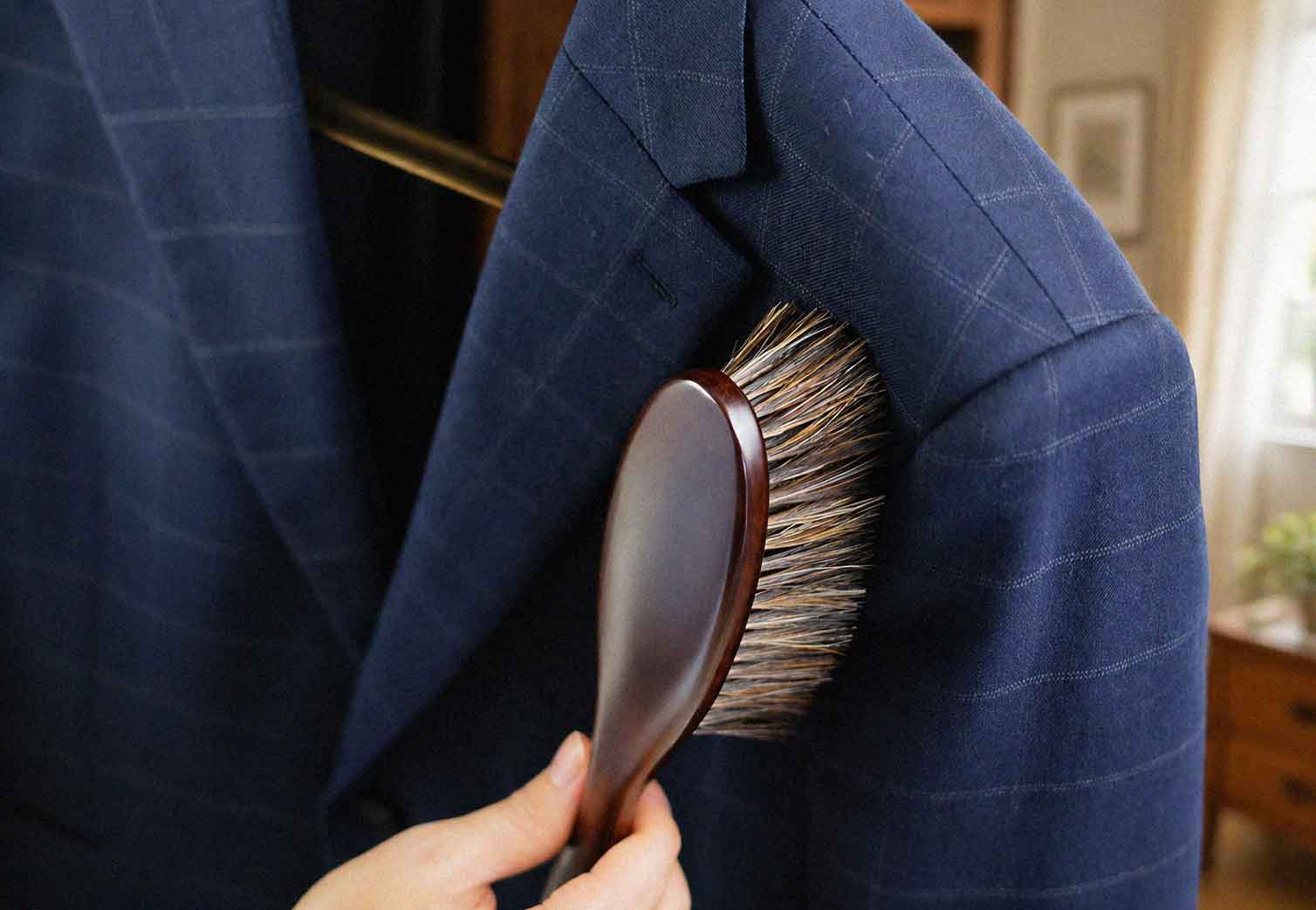
The second is brushing. A soft-bristled brush, drawn in the direction of the weave after each wear, removes dust and particles that, over time, accumulate between the fibres and accelerate wear. It is a gesture of a few seconds that Neapolitan tailors have practised for generations — and that many clients discover is almost meditative.
The third is the right hanger. Forget wire or thin plastic hangers. A wooden hanger with shoulder curvature distributes the weight of the jacket evenly, preserving the structure of the natural shoulders — that relaxed drape that defines Neapolitan construction. For trousers, a hanger with clips or a padded bar avoids unwanted creasing.
Pressing as a last resort
In the bespoke world, pressing is the exception, not the routine. A well-constructed jacket, correctly hung, rarely needs an iron. But when it does — a long journey in luggage, an unexpected rainy day — press with delicacy.
Steam iron, temperature appropriate to the fabric. Never the iron directly on the surface: placing a clean cotton cloth between the iron and the piece protects against the sheen that direct heat creates on wools and cashmeres. It is the same principle the tailor applies in the workshop: the cloth deserves a protective layer between it and any source of heat.
Storage between seasons
When the season changes and flannel gives way to linen — or vice versa — storage deserves particular attention. A cool, dry, well-ventilated place is essential. Direct sunlight fades; moisture creates mould; excess heat dries out the fibres.
For pieces that will be stored for weeks or months, breathable cloth bags are valuable allies. They protect against dust and moths without trapping moisture — something that plastic covers, however practical they seem, do with undesirable efficiency. Plastic creates a microclimate that wool cannot forgive.
A sachet of lavender or cedar inside the bag completes the protection. These are the same solutions that the great European ateliers use to store fabrics worth hundreds of euros per metre — because they work, without chemistry and without hurry.
Time as ally — not adversary
There is a principle that connects the care of bespoke garments to almost everything that matters in the world of artisanal tailoring: time. Time to build, time to fit, time to adjust. And, once made, time to care.
A handmade tailoring piece, with floating canvas and long-fibre cloth, is not merely durable — it improves. The cloth acquires character. The hand-stitched canvas, because it is not glued, begins progressively adapting to the warmth and form of the body that wears it. This takes months. After a year of regular wear, the jacket knows its owner in a way that no new piece can ever imitate.
The small marks of use tell a story that is only yours. Like a leather shoe that moulds to the foot, like a good wine evolving in the bottle, the bespoke suit has a unique relationship with time — provided one respects what time needs to do its work.
It is not much. In fact, it is almost nothing. A wooden hanger. A soft brush. The patience not to wash when washing is not needed. And the awareness that certain things — the best things — were not made to be discarded.
They were made to last.
If you have questions about caring for your piece, or need a recommendation for a specialist dry-cleaner, a conversation with the atelier is always a good starting point.
Share