The Piece That Starts Everything
Why navy blue is not a conservative choice — it is the most intelligent starting point for building a wardrobe of intentional tailoring with lasting relevance.
There is a question I receive often at the atelier, worded differently each time but carrying the same undercurrent of anxiety: where do I begin? My answer is always the same — and it tends to surprise those expecting something more dramatic. You begin with navy.
There is a tendency, when one first discovers the world of bespoke tailoring, to want to start memorably. The most exceptional fabric, the most daring cut, the colour nobody will overlook. I understand that impulse — it is the same one that makes someone want to watch The Godfather Part II without having seen the first. But just as every scene in Coppola's saga depends on what came before, tailoring asks that one establish a foundation before venturing into more particular territory.
That foundation has a name, a colour, and a weight. And it is less heroic than it sounds.
What navy carries
Navy — blu notte, as the Neapolitans prefer — is the most intelligent colour in a man's wardrobe for a reason that has less to do with fashion than with optics. It is serious enough for a formal environment and alive enough for a social occasion. It does not disappear under artificial light the way charcoal does; it does not close in the way black can. It converses with almost any other colour without submission — with burgundy, with brown, with khaki, with white, with stripes and with solids.
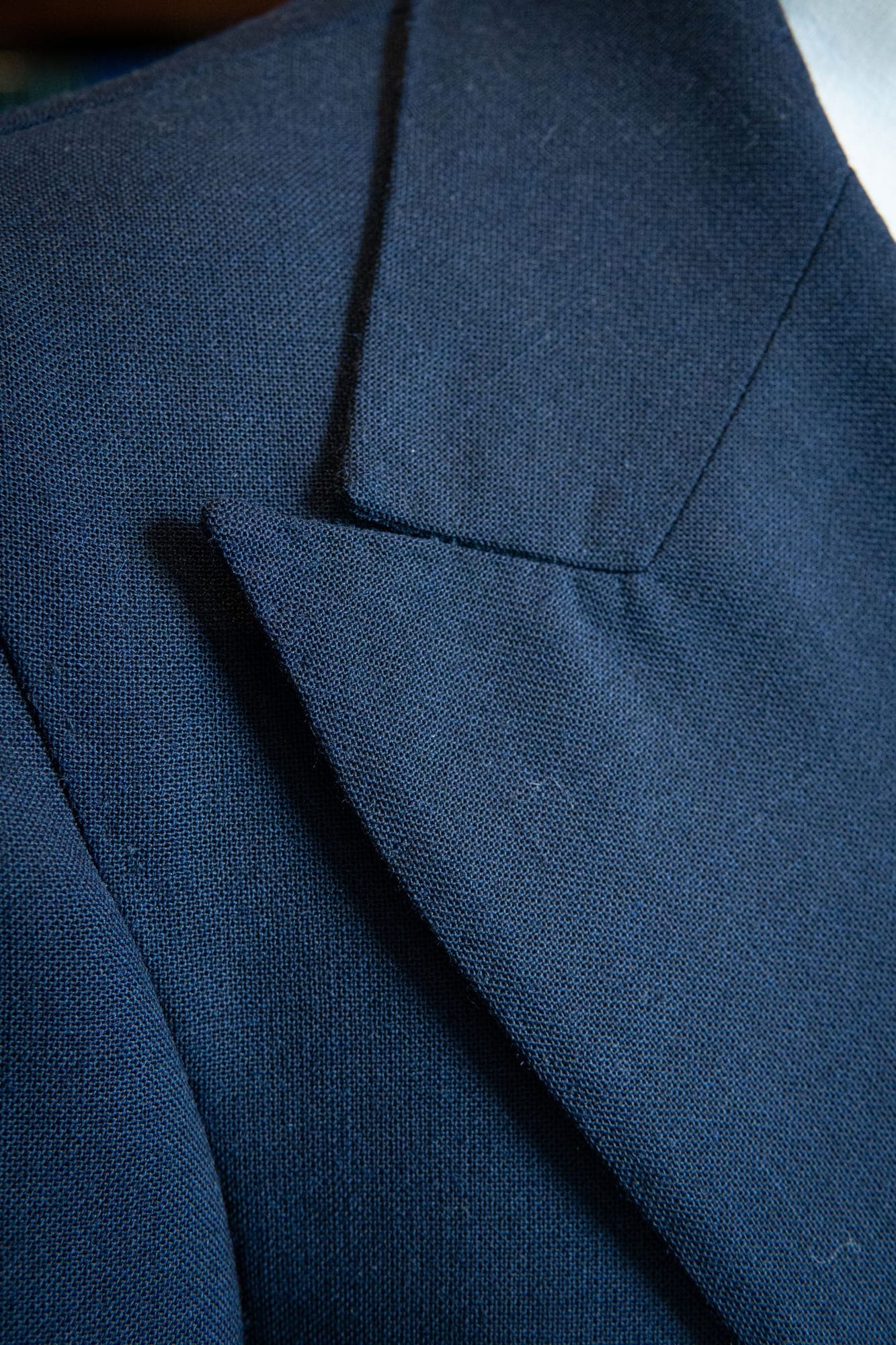
But what makes navy truly indispensable is not its versatility of colour — it is what it allows one to reveal. When the colour does not call attention to itself, what remains for the eye to appreciate is the construction: the fall of the shoulder, the drape of the chest, the proportion between jacket length and trouser rise. In a well-made navy suit, nothing is hidden. Every constructive decision appears with clarity.
This is why navy is also, for the tailor, the most honest cloth. It is where one most clearly sees whether the work was done well — and where one most clearly feels, when it was not.
Versatility is not compromise
There is a misconception worth addressing — the idea that choosing a versatile piece is a cautious, almost cowardly choice. That true personality expresses itself only in the more daring decisions.
I disagree. The choice of a piece that functions in many contexts is not an abdication of style — it is an expression of intelligence. Cary Grant did not wear suits in neutral colours because he lacked personality. He wore them because he understood that true elegance does not need to announce itself. Grant's navy said, without saying: I know what I am doing here.
A well-constructed navy suit has the dignity of needing no justification. It enters a meeting, a wedding ceremony, an elegant dinner or a working afternoon without ever appearing out of place. That is not versatility as a euphemism for mediocrity — it is precision. The right piece in the right moment.
The wardrobe as conversation
When I work with a client on their first bespoke piece, navy is not merely an aesthetic suggestion. It is a strategic decision. Because the suit does not exist in a vacuum — it will coexist with other pieces, will create combinations that do not yet exist, will open possibilities that only reveal themselves through wear.
Once navy is well established in the wardrobe, it becomes the interlocutor for everything that comes after. The second suit can be more personal — a charcoal with a fine herringbone, a petrol blue that seems to change colour with the light, a warm brown that speaks to the favourite shoes. The third piece can be bolder still. Each new acquisition has the solidity of navy as its anchor.
This is how a tailoring wardrobe is built: not all at once, not with a single stroke of audacity, but as a conversation that deepens over time. Navy is the first sentence — and, like every good opening sentence, it must be clear, precise, and capable of sustaining what comes after.
The tropical wool that São Paulo demands
In São Paulo, where heat is an almost permanent presence and formality has historically given way to a particular local elegance, navy finds its best expression in lightweight fabrics — tropical wools with open weaves that allow air circulation without sacrificing drape.
There is no need to resign oneself to linen as the only option for the heat. A tropical wool in navy has something linen cannot as easily offer: consistency. It holds its shape through an entire day of meetings without losing form, without accumulating the sitting marks that linen gathers by afternoon. It is the choice of those who want to arrive at dinner looking as they did when they left home in the morning.
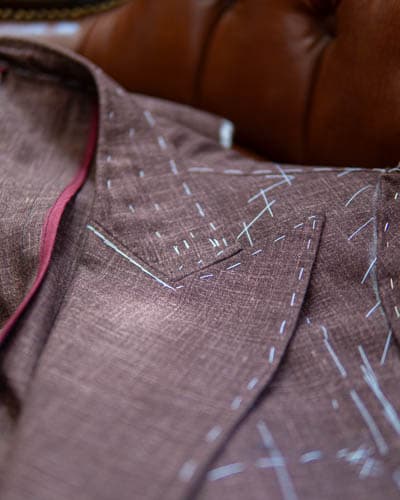
The construction we practice at the atelier — sfoderato, without full lining, with hand-stitched floating canvas — amplifies this lightness. The jacket breathes. The unstructured shoulder, in the Neapolitan tradition, follows the gesture without resistance. Navy, in its version most honestly suited to this city's climate and rhythm.
The first chapter
When someone tells me they want to begin building a bespoke tailoring wardrobe but does not know where to start, I do not offer a list of rules. I tell a story about the first piece — about what it must do before being beautiful, before being special, before being memorable.
It must work. It must be honest to the body and generous in use. It must allow the man who wears it to go anywhere without thinking twice. It must last — not merely in terms of material, but in relevance. It must be a constant presence in the wardrobe, not a piece held in reserve for grand occasions that rarely come.
Navy does all of this. With the right construction, the right fabric and proportions thought through for the body that will wear it, it becomes the foundation upon which everything else makes sense.
It is not the most dramatic chapter of the story. But it is the one that makes all the others possible.
If this is the conversation you are having with your wardrobe right now, the atelier is open for a first visit — no commitment, no form to fill. Simply a conversation about where to begin.
Share