Pitti Uomo — What Happens in Florence Twice a Year
Why the world's greatest menswear event matters for those who dress with intention in São Paulo — and what Pitti Uomo has to do with Naples and with Brazil.
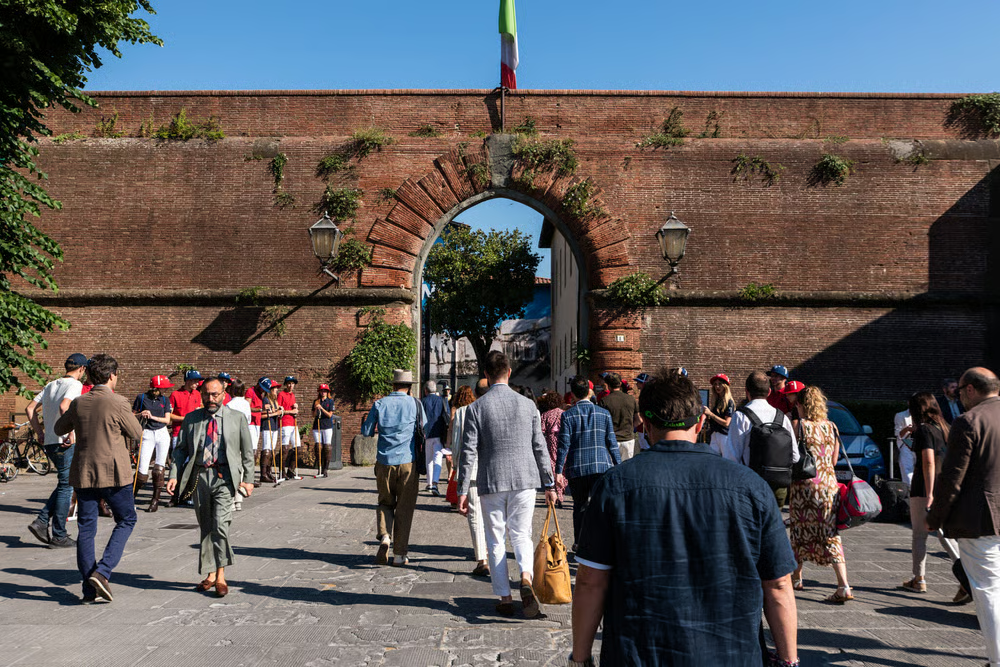
Twice a year, in the gardens of the Fortezza da Basso in Florence, a gathering takes place that has no equivalent in the fashion calendar. It is not a runway show. It is not a business convention. It is not exactly a festival. Pitti Uomo is all three at once — and understanding what happens there is understanding a great deal about where menswear is heading.
Founded in 1972 as an Italian menswear trade fair, Pitti Uomo spent decades being primarily a business event: a place where brands presented their collections to international buyers, and where orders were placed before pieces reached shops. That core still exists. But around it grew something that was not in the original plan: a cultural ecosystem that transforms Florence, for four days twice a year, into the gravitational centre of everything happening in the world of quality menswear.
What happens inside and outside the Fortress
The Fortezza da Basso is a sixteenth-century Renaissance fortress, built by architect Antonio da Sangallo il Giovane at the request of Alessandro de' Medici. That a menswear event takes place within its walls — with its manicured gardens and architecture that combines power and elegance — says something about the nature of what happens there.
Inside the Fortress, five or six pavilions house brands from around the world presenting their collections to buyers, fashion editors and journalists. The curation is rigorous: not just any brand enters Pitti. There is a selection process that favours the artisanal, the particular, the work that has a point of view. The brands presenting at Pitti are not necessarily the largest — they are the ones that have something to say about how a man can dress with intention.
Outside the Fortress, in the streets of Florence, the other Pitti takes place — the one most people know from the photographs that circulate on social media. It is the Pitti of the peacocks: men who arrive at the fair in elaborate, often extravagant compositions, built to be photographed by the street photographers who line the streets of the historic centre. These characters — tailors, bloggers, editors, regular clients — have become, over the years, an indispensable part of the event's identity. They are the public face of a world that, from the inside, is far more subtle and technical.
Why Naples is always present
One of the things that most strikes a first-time visitor to Pitti is the omnipresence of Neapolitan tailoring. Not as marketing, not as geographical assertion — as an aesthetic philosophy that permeates the event.
The most respected brands circulating at Pitti are, for the most part, directly or indirectly connected to the Neapolitan tradition. Kiton, which produces some of the world's most expensive jackets at its factory in Arzano, on the outskirts of Naples. Cesare Attolini, which maintains the camicia construction with a rigour that impresses even the most experienced connoisseurs. And Rubinacci — the house that, more than any other, represents the Neapolitan spirit in the world: the leggerezza, the sprezzatura, the idea that elegance must appear inevitable, never laboured.
This omnipresence is not coincidence. Pitti Uomo was, for decades, the space where Neapolitan tailoring proved to the world that its tradition was not nostalgic localism, but an aesthetic and technical response perfectly suited to the present. The Neapolitan thesis — that the jacket should serve the body, not structure it; that heat and daily life demand lightness, not apparatus — found in Florence its broadest stage.
What Pitti reveals about the future of dress
There is a productive tension at Pitti Uomo that defines its relevance: it is an event that celebrates tradition and simultaneously questions what tradition can be today.
Pure tailoring brands coexist with high-quality American workwear brands, with Japanese designers who reinterpret the suit from the inside, with Portuguese artisans making berets and ties using medieval techniques. The connecting thread is not a specific style — it is the belief that quality and intention in dress have permanent value, regardless of the form they take.
What Pitti shows, edition after edition, is that men around the world are increasingly less interested in the disposable and increasingly interested in the durable — not merely as an environmental attitude, but as an aesthetic posture. A tailored suit made to last decades is not the opposite of modernity. It is one of the most contemporary ways of responding to a world that produces and discards at industrial speed.
Why this matters in São Paulo
São Paulo has no Pitti. But it has tailors, a growing community of men who care about what they wear, and a relationship with Italian culture that is, in the Brazilian context, singularly deep. The Italian immigration that shaped São Paulo's identity through the twentieth century — the Matarazzo, the Puglisi, the Buonavita — created an affinity with the Italian artisanal tradition that has no parallel elsewhere in Brazil.
In this context, Pitti Uomo matters to São Paulo because it functions as a calibrating reference: it shows what is happening at the frontier of what a man can do with clothes when he treats that choice for what it is — a language, not a uniform.
For us at the atelier, Pitti is a source of observation and conversations. We see what Neapolitan tailors are exploring in terms of construction. We check how fabrics are evolving — which mills are developing new proposals in weight, weave and fibre. We discover what the most informed men in the world are searching for.
And we translate to Itaim Bibi what is relevant for the man who lives and works in São Paulo. Not copied, but filtered — adapted to the heat, the rhythm, the sophisticated informality of this city that is still inventing its own elegance.
The next edition of Pitti Uomo takes place in June, in Florence. If the subject interests you, the atelier is a good place to continue the conversation about what happens when tradition and contemporary life find the same shoulder.
Share