The Rolling Lapel
What the lapel roll is, how it is built with pad stitches and horsehair canvas — and what that three-dimensional curve reveals about a jacket before wearing it.
The first time Guilherme Franco visited Italy, what caught his attention was not only the monuments — it was also the lapels. Wide, generous, curved with a softness he had never seen in any Brazilian jacket. It was not the cut, not the colour — it was the way the lapel rested on the chest, as if it had chosen that place of its own accord.
What he was seeing had a name. And that name, for those who know tailoring, says more about the quality of a jacket than any Super number on the cloth label.
What the lapel roll is
The lapel of a jacket is not simply a folded piece of cloth. It is a construction — a sequence of the tailor's decisions that determines how the cloth will curve, in what direction, with what radius, and where it will naturally rest on the chest.
The lapel roll describes precisely this phenomenon: the three-dimensional curvature that the lapel assumes when constructed correctly, creating a gentle volume that is not the lapel simply folded over itself, but the lapel finding the form given to it during construction.
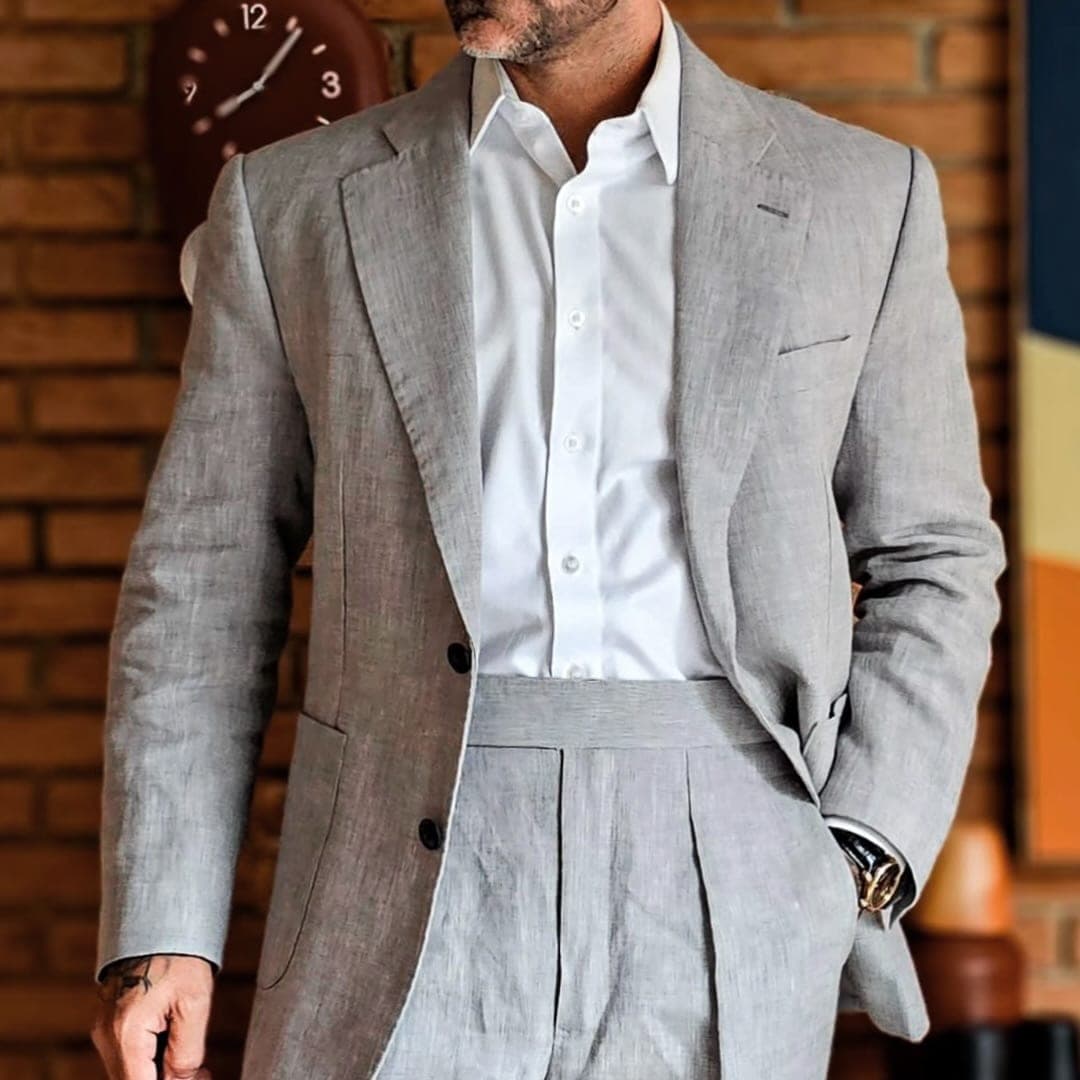
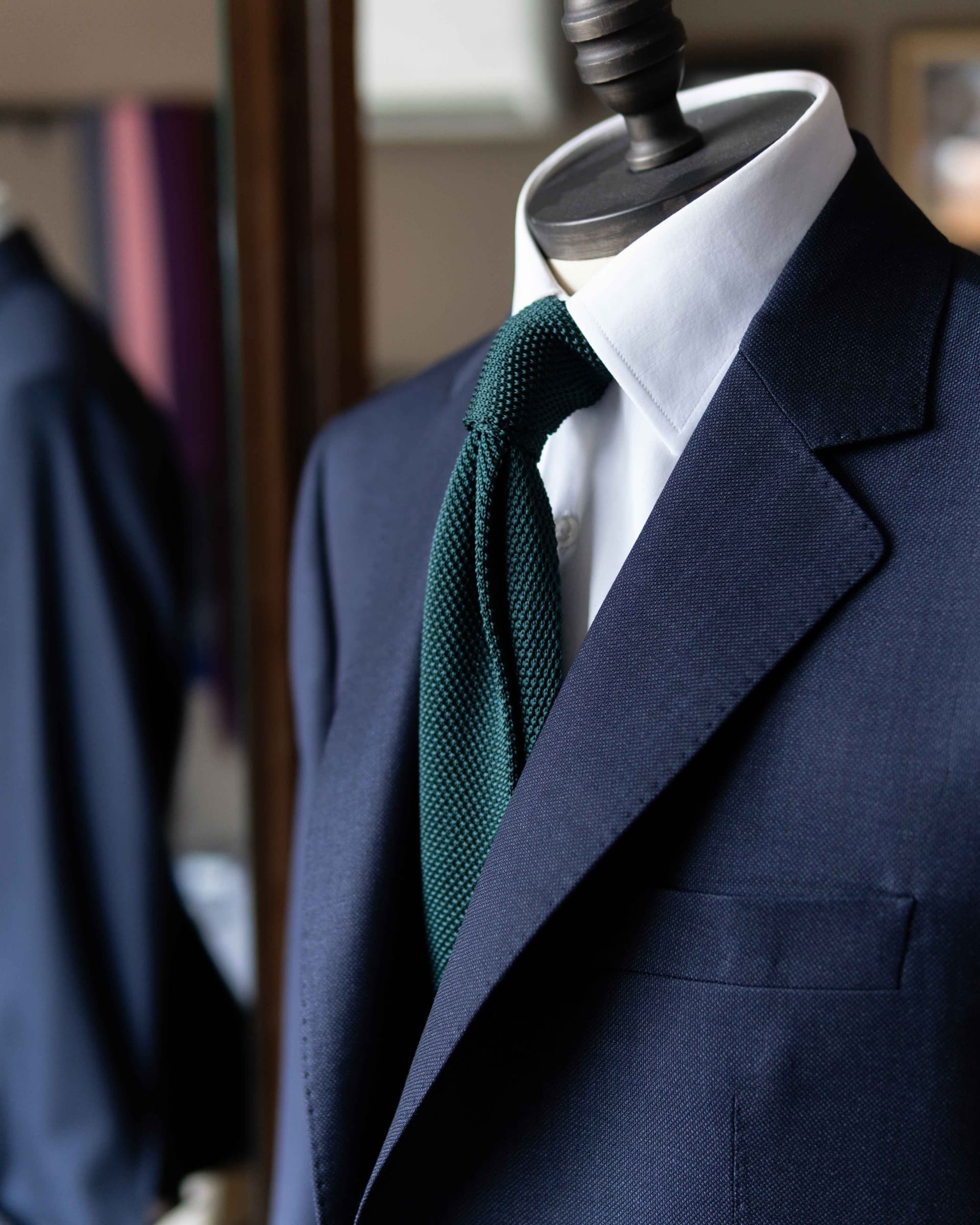
In a jacket with a well-executed lapel roll, the lapel curves gently downward from the first button, creating a curved line that frames the chest with generosity. Seen from the side, this curve is evident — the lapel is not flat, not pressed against the chest, but floats slightly forward from the jacket cloth, with a presence that is at once discreet and unmistakable.
In a jacket without a lapel roll — or with one executed mechanically — the lapel is flat. It may have the same width, the same cloth, the same cut. But it lacks the volume, the three-dimensionality, that softness that makes the Neapolitan lapel so distinctive.
How the lapel roll is formed
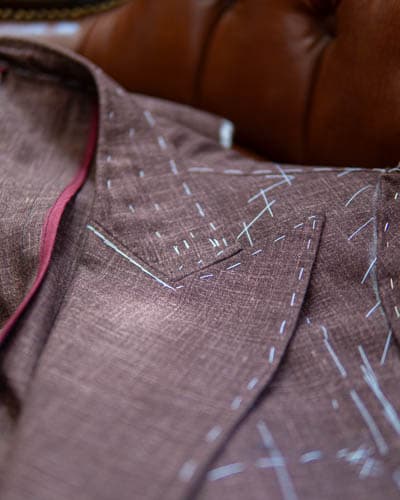
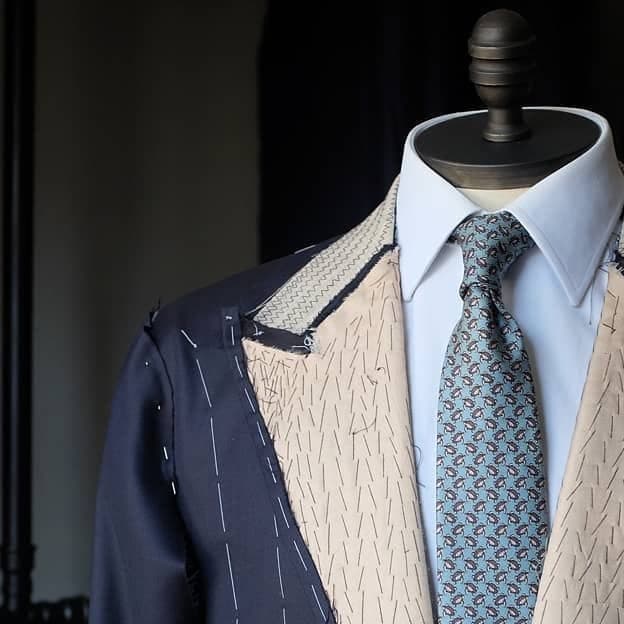
The curvature of the lapel is not born from the cut. It is born from the pad stitches — the same long, loose stitches that build the floating canvas of a full canvas jacket.
The tailor, working the canvas of the lapel, places pad stitches in a specific direction and with calculated tension. These stitches progressively create a tendency in the cloth to curve in one direction. When the canvas is steamed and shaped over a cushion with the desired lapel form, it "memorises" the curvature — and holds it.
This memory is what allows the Neapolitan jacket to have a lapel that, even after being folded and stored, spontaneously returns to its form when worn. It is not the rigidity of an iron holding the shape; it is the memory of the horsehair that, gently, recalls it.
The process of constructing the lapel in a well-made full canvas jacket takes between four and eight hours of manual work. This does not include the basting (the first provisional stitching that joins the pieces), nor the trimming (the finishing of the edges). It includes only the pad stitches that give the lapel its definitive form.
In a jacket with fused interlining, the lapel has none of this memory. It has the form that the heat press gave it — and that form is flat, two-dimensional, immobile. Over time, the press deteriorates the glue, and the lapel progressively loses whatever little form it had.
Lapel width as declaration
The lapel roll exists at any lapel width — but it is most evident, and most celebrated, in the wide lapels of the Neapolitan tradition.
The wide lapel is not merely an aesthetic choice. It is a philosophical one. A narrow lapel belongs to tailoring that values geometric precision, clean lines, structure that announces itself clearly. A wide lapel belongs to tailoring that values visual generosity, the presence born of softness, the elegance that does not need angles to be seen.
Sartoria San Paolo works with lapels that respect the classical proportion — wide enough to create roll, narrow enough not to dominate. The starting point is always the conversation with the client: what kind of presence does this piece need to have? What visual vocabulary does it need to speak?
The lapel is the most visible answer to those questions.
What the lapel reveals before you wear the jacket
There is a simple test that separates, with some precision, the informed from the uninitiated in an atelier or tailoring shop. It does not involve feeling the interlining or checking the stitching. It involves only looking at the lapel of the jacket as it hangs.
A lapel with roll has movement, even when still. It has a curved line that begins at the gorge — the notch between lapel and collar — and descends gently to the first button. It has depth: the tip of the lapel sits slightly further forward than its base.
A lapel without roll is flat. It may be beautiful, may be well finished — but it is quiet, without that gentle tension that is the mark of handwork.
Once, a client came to the atelier with a jacket he had purchased at an international boutique, presented as "Neapolitan" and sold at a price that would justify that origin. He wanted a second opinion. We looked at the lapel. It was perfectly flat, pressed against the jacket as if embarrassed to occupy space. There was no roll, no memory, no handwork that creates that form.
It was not Neapolitan. It was merely expensive.
The lapel roll cannot be simulated. It only exists where there is work — where there is a tailor who spent hours with the piece in hand, placing stitches with the patience of one who knows the result will not appear immediately, but will persist for decades.
It is one of the most silent details of tailoring. And one of the most honest.
If you want to see up close what the lapel roll means — and how it changes the perception of a jacket when it is present — a visit to the atelier resolves what words can only approximate.
Share