The Skeleton of the Jacket
Full canvas, half canvas and fused interlining: the complete guide to a suit's internal construction — and how to identify what you have before you buy.
When you buy a jacket, you are buying what you can see — the cloth, the cut, the colour. But what will determine how that jacket behaves in daily life, how it ages over the years, whether it will improve or deteriorate with wear, is something that cannot be seen: what is inside it.
There is a test that tailors have taught their apprentices since the time when tailoring was passed from generation to generation in the alleyways of Naples. It is simple, takes thirty seconds, and reveals more about the construction quality of a jacket than any brand label.
Fold the jacket in half lengthwise. If it returns to its original form smoothly, of its own accord, as if it has memory — that is a good sign. If it stays folded where you folded it, forming a crease that takes time to disappear — that is a less encouraging sign. If it recovers rigidly, with a sudden movement — that is a sign that the interlining is bonded to the cloth with adhesive, not stitched.
The test is not infallible. But it is a beginning.
Why internal construction matters
The internal structure of a jacket is what engineering is to a building: what nobody sees, but on which everything depends. It determines how the jacket falls over the shoulders, how the chest forms, how the lapel behaves, how the piece responds to the movement of the body through an entire day.
There are three main types of internal construction in the suit market. Each represents a different philosophy of how a jacket should be made — and each has specific consequences for the person who wears it.
Full canvas: the construction that time respects
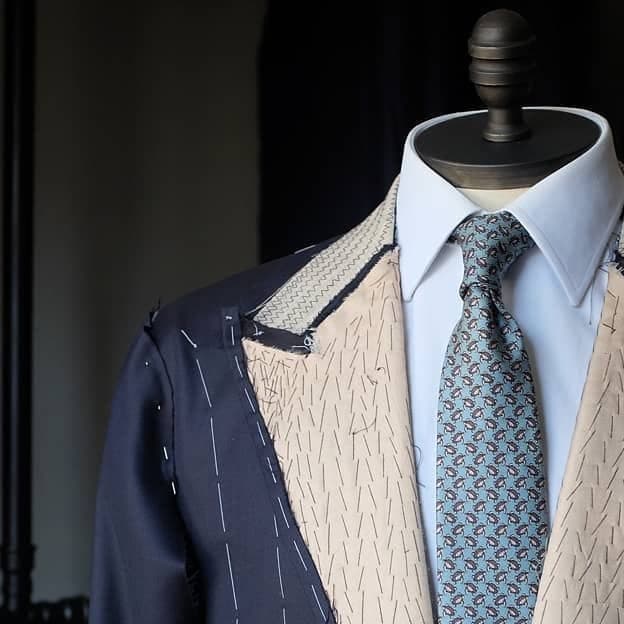
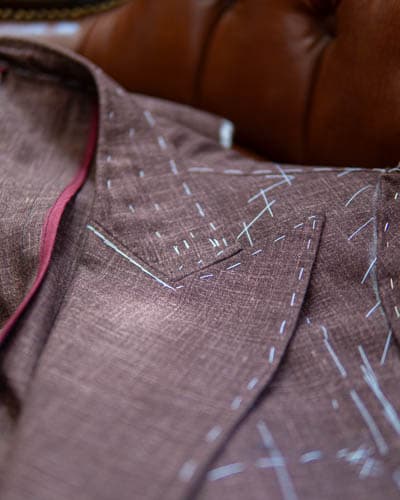
In full canvas, the jacket is built on a layer of interlining made of horsehair and wool — the canvas — which runs the entire length of the piece, from shoulder to hem. This interlining is not glued: it is hand-stitched to the body of the jacket with pad stitches, the long, loose stitches that the tailor works with millimetric patience.
The result is a piece that is literally alive: the floating canvas breathes alongside the cloth, progressively moulds itself to the warmth of the body, and over time creates a drape that is specifically its owner's. No new full canvas jacket falls the same way as one that has been worn for a year by the same person. The second is better — more precise, more adapted, more inevitably theirs.
The disadvantage of full canvas is the production cost: the hours of manual labour required significantly increase the price of the piece. And durability requires care: this type of construction needs a skilled tailor for any subsequent adjustment, because it is not a matter of simple stitching — it is a matter of rebalancing an architecture.
Full canvas is the construction that bespoke tailoring adopted as its standard for centuries. It is what is made in Naples, on Savile Row, in the great ateliers of Florence and Tokyo. It is what we make at the atelier.
Half canvas: the honest balance
In half canvas, the floating interlining covers only the upper half of the jacket — from shoulder to the pocket line, approximately. The lower half is stabilised with firmer materials, but without the same architecture of pad stitches.
For most clients in real-world contexts, half canvas produces results very close to full canvas in the areas that matter most visually: the chest, the lapel, the shoulder. The difference reveals itself over decades of use — not months.
Half canvas is the standard construction of the finest made-to-measure brands and some high-quality ready-to-wear lines. When well executed by an experienced tailor, it is an honest and high-quality choice — not a concession, but a calibration of cost and result.
Fused: what appears the same but is not
Fused interlining is the standard construction of the garment industry. It involves applying, with heat and pressure, a thermoplastic resin between the outer cloth and the lining, joining the layers into a single stable surface.
The initial result can be impressive. A newly made fused jacket has a clean chest, a well-formed lapel, an appearance that can be difficult to distinguish from half canvas at first glance. The problem lies in the long term.
The resin bonding the layers begins to deteriorate with wear, cleaning and temperature variation. Delamination — the process by which the resin begins to separate from the cloth — creates visible bubbles on the chest of the jacket, especially on warm days. The drape loses uniformity. The lapel loses its gentle curve. The piece does not improve with use: it progressively deteriorates.
This is not a moral judgement on brands that use fused — it is a technical observation about material behaviour. Many excellent brands use fused in their entry lines and half canvas or full canvas in their top lines. The problem arises when the terminology is unclear and the client pays for a construction they did not receive.
How to identify a jacket's construction
Beyond the folding test mentioned at the opening, there are other methods for checking a jacket's construction.
The most direct: take the jacket by the lapel, between thumb and forefinger, and gently pinch the outer cloth and canvas. In a full canvas or half canvas, you will feel the two layers slightly separate — the canvas sliding smoothly under the outer cloth, because the two layers are not bonded. In fused construction, you will feel no separation: the layers are fused into a single rigid surface.
The second method: examine the jacket against a good light source, with the lining open. In the chest area, a well-made full canvas jacket will show subtle irregularities on the inner surface — the pad stitches creating a very slight texture that the trained eye recognises immediately. A fused jacket will show a perfectly smooth surface.
These tests are useful, but they do not replace a conversation with whoever made the piece. Asking directly is always the best way to know what one is buying.
What to choose
The answer depends on context. For high-quality bespoke pieces intended to last decades, full canvas is the standard that justifies the investment. For quality pieces, half canvas is a balanced and honest choice. For entry-level ready-to-wear, fused is the market reality — and there is no disgrace in that, as long as one knows what one has.
What matters, before any decision, is knowledge. That the construction not be a mystery the salesperson can fill with any word. That the client who invested in a suit understands what is inside it — and that this understanding informs how they care for the piece, how often they wear it, and how long they expect it to last.
The jacket you wear tells a story. Knowing how it was built is the first chapter.
If you want to see and feel in practice the difference between full canvas and the alternatives, the atelier is open for a visit. We have examples of all three constructions, and we enjoy explaining what is inside each piece we make.
Share