The Invisible Soul of the Jacket
What horsehair canvas reveals about a handmade suit — and why this invisible detail defines everything you will feel when you wear it, from the first fitting.
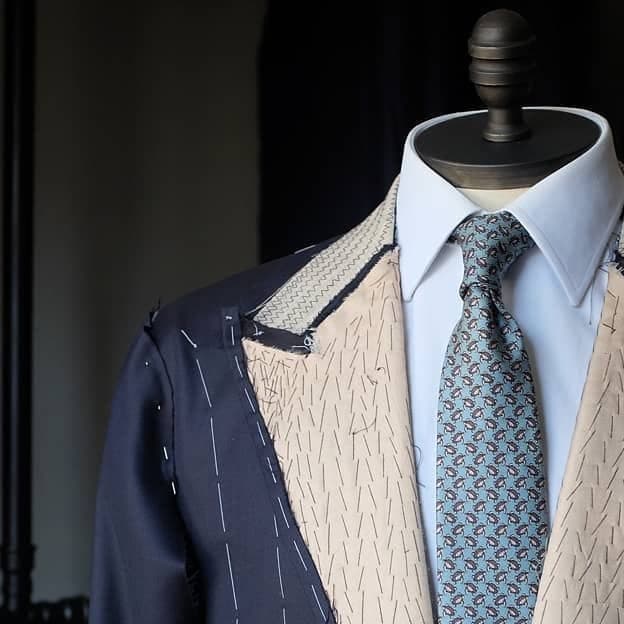
There is a part of the jacket that nobody sees — and it is precisely this part that determines whether the piece is exceptional or merely adequate. The horsehair canvas, known in the tailoring tradition simply as canvas, is the internal structure that gives body, drape and personality to every handmade jacket. It appears in no photograph of the finished product. No client mentions it upon receiving their piece. But it is there — and it is what separates, with complete clarity, the artisanal from the industrial.
What horsehair canvas is
The canvas is an intermediate layer made of horsehair mixed with wool and cotton. It sits between the outer cloth and the jacket lining, stitched point by point to the body of the piece — never glued. This process, called floating canvas, is what allows the jacket to move naturally and, over time, to mould itself to the body of the person who wears it.
Horsehair has a property that makes it singular among textile construction materials: memory. When shaped with steam and stitching, it retains the form given to it — but still allows the cloth to breathe, allows the piece to adapt to movement without resistance. It is a firmness that does not impede flexibility; a structure that serves motion.
In industrial tailoring, this layer is replaced with a fused interlining — a resin applied with heat that collapses the layers of the jacket into a single surface. The initial result may appear similar to full canvas. But the difference reveals itself with wear: the fused interlining hardens over time, forms bubbles where the glue begins to give way, loses the drape it had when new. A piece with fused construction does not improve with use — it deteriorates.
Neapolitan construction: the pad stitch as gesture
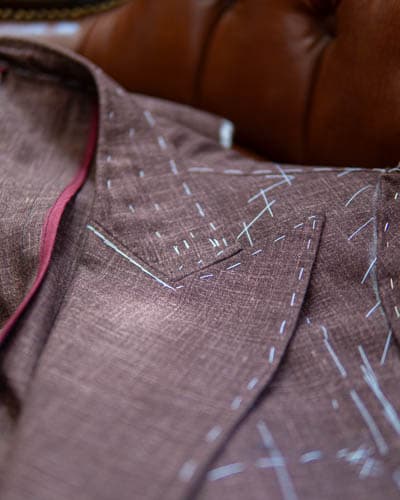
In the Neapolitan tradition we practise at the atelier, the canvas is sewn by hand with long, loose stitches — the so-called pad stitches. Each stitch is placed with intention: the density, direction and tension of the stitches determine the final form of the jacket.
This is not an abstract technical observation. It means that the tailor, placing each pad stitch, is making a decision about how the jacket will drape. An area with denser stitches will have more structure; an area with more widely spaced stitches will have more lightness. The hand-rolled lapel — that soft curvature that distinguishes the Neapolitan jacket — exists only because the tailor worked the pad stitches in a specific direction and tension to create that form. It is not a mould imposing the curve. It is the stitching suggesting it, and the horsehair holding it.
The process is slow. A single jacket can require more than 60 hours of manual work in the canvas construction alone. But the result is a piece that accompanies the body like a second skin — without rigidity, without unnecessary weight, with that ease of movement that characterises the finest Neapolitan jackets.
Full canvas, half canvas, and the difference time reveals
A distinction worth making: the difference between full canvas and half canvas. Both are superior to fused construction; but they are distinct constructions.
In full canvas, the floating interlining runs the entire length of the jacket — from shoulder to hem. Every centimetre of the jacket has the structure of hand-stitched horsehair. It is the most complete construction, the one requiring the most hours, and the one producing the most uniform and durable drape over decades.
In half canvas, the floating interlining covers only the upper half of the jacket — from shoulder to pocket line. The lower half is stabilised with a slightly firmer interlining, but without the same architecture of pad stitches. It is an honest and quality construction, producing results very close to full canvas and, for many clients and many pieces, the most balanced choice.
What differentiates the two constructions is not initial quality — it is behaviour over time. With years of wear, full canvas progressively reveals how it has adapted to its owner's body. Half canvas reveals the same in the upper half; in the lower, the behaviour is more stable and less alive.
The canvas and the Neapolitan philosophy
There is a connection that is rarely made explicit, but that explains why the Neapolitan tradition insists on this construction when the rest of the world moves in another direction: the floating canvas is, in essence, the same philosophy of the unstructured shoulder applied to the interior of the jacket.
Just as the Neapolitan shoulder refuses rigid armature in favour of a construction that submits to the body, the floating canvas refuses gluing in favour of a structure that coexists with the cloth without dominating it. In both cases, the principle is the same: the clothing serves the body, not the other way around.
This has practical consequences that go beyond aesthetics. A jacket with floating canvas, well cared for, can last 20, 30 years — and with each year of wear it becomes more precisely its owner's. A jacket with reasonably good fused construction, after five or six years, begins to show signs of deterioration that cannot be repaired.
At Sartoria San Paolo, every jacket carries within it weeks of work that nobody will see. The hand-stitched horsehair canvas is what separates a piece that fits from a piece that belongs. The invisible, here, is everything.
If you want to understand more about the construction inside our pieces — or simply to see and feel the difference between full canvas and the alternatives — the atelier is open for a visit. Sometimes it is simpler to touch than to read.
Share