On third, two thirds.
The invisible grammar between a suit that covers and a suit that reveals.
There is a moment, during the first fitting of a bespoke suit, when the client looks in the mirror and notices something he cannot name. Something has changed. He appears, for the first time, proportional. The legs seem longer. The torso more defined. The whole communicates an authority that no brand label can reproduce.
What happened is not magic. It is mathematics — or, more precisely, it is the application of a principle that great tailors have known for centuries and that contemporary fashion, in its hurry for novelty, decided to ignore.
At Sartoria San Paolo, every conversation about a piece begins with this principle. Before the cloth colour, before the button choice, before any decorative detail, there is the most fundamental decision: how this body will occupy space.
The body divided in half — and what is lost
To understand what the classical proportion offers, one must first understand what current fashion has taken away. Over recent decades, mainstream menswear adopted a silhouette that divides the male body into two equal halves: low-rise trousers, shortened jackets, and a visual waist line that falls at the hip. The result is a 50/50 proportion — half torso, half leg.
Seen from a distance, this division in half seems intuitive. But the human eye does not work that way. When the silhouette cuts the body exactly in half, the visual effect is one of stagnation: the torso appears elongated, the legs shortened, and the whole figure loses verticality. Alan Flusser, in Dressing the Man, devotes entire chapters to this phenomenon. Proportion, he argues, is the invisible foundation of all elegance in men's dress.
One third above, two thirds below
Classical tailoring proposes a different, and radically more favourable, division. Rather than cutting the body in half, it distributes the silhouette as one third for the upper portion and two thirds for the lower. The effect is immediate: the legs appear longer, the torso gains definition without appearing compressed, and the whole figure projects verticality.
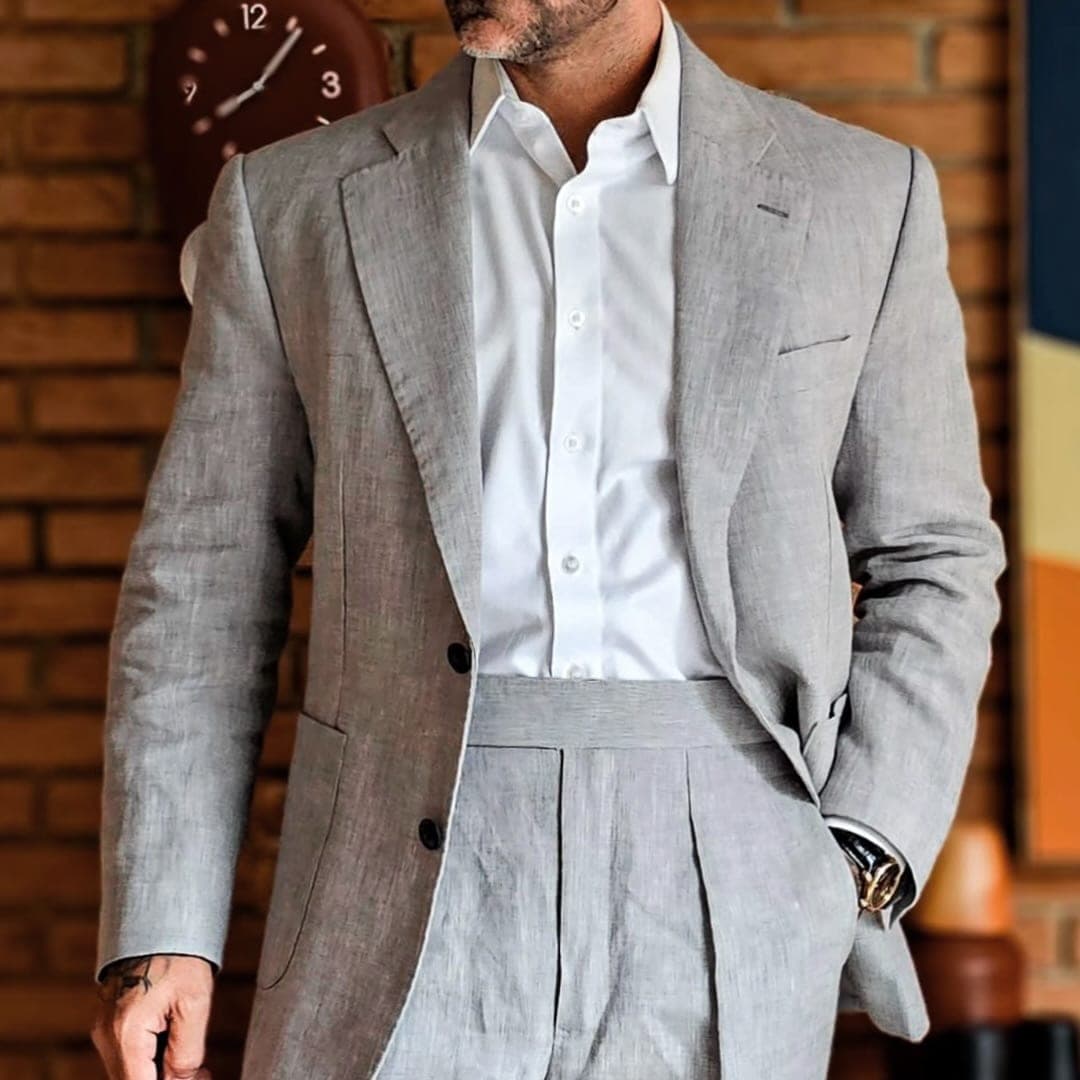
In practice, this proportion is born of two interdependent decisions. The first is the rise of the trousers. When the trousers rest at the natural waist — not at the hip, not at the belt line of jeans — they automatically lengthen the line of the legs, creating those two lower thirds that give the silhouette its characteristic elegance. The second decision is the length of the jacket, which should cover what it needs to cover without exceeding: at the front, the full length of the fly; at the back, complete coverage of the seat. Neither more, nor less.
This calibration is everything. When the jacket is too short and the trousers too low, one returns to the 50/50. When the jacket extends excessively, another problem arises: a dated, heavy air that communicates nostalgia rather than elegance.
This is not nostalgia
Let it be said clearly: speaking of classical proportion is not speaking of an old-fashioned look. It is not a defence of 1950s costume, nor a rejection of the contemporary world. It is, simply, the application of a visual principle that works — regardless of era, context or the personal style of the wearer.
Cary Grant did not appear "old-fashioned" in the 1960s. Marcello Mastroianni did not appear "dated" in Fellini's films. Both obeyed, consciously or intuitively, the same logic of proportion. Their suits had higher-waisted trousers, jackets at the correct length, and a silhouette that divided the body asymmetrically — and it was this asymmetry that made them appear so naturally elegant.
What is being described is not a style. It is a grammar. And, like all grammar, it can be applied with different accents: more formal or more relaxed, more structured or softer, more British or more Neapolitan. Proportion is the skeleton; personal style is the skin.
Micro-proportions: when tie and lapel converse
The rule of one third and two thirds governs the silhouette as a whole, but there is another level of proportion — more subtle, more intimate — that operates within the jacket itself. It is the dialogue between the width of the lapel and the width of the tie.
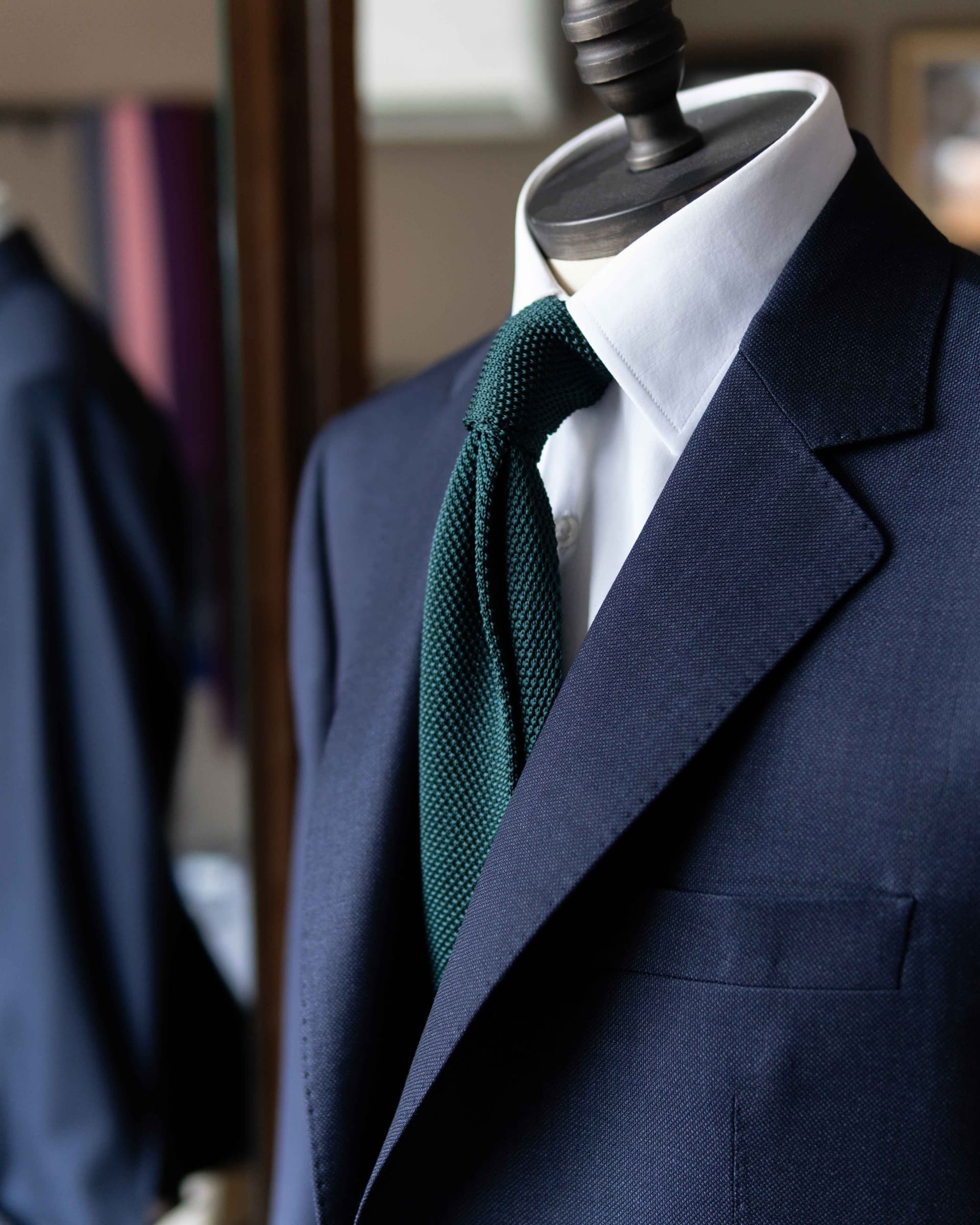
The principle is straightforward: the visual elements of a composition must be in harmony of scale. A wide lapel, such as those that define classical Neapolitan tailoring, calls for a tie with presence — a voluminous four-in-hand knot, a silk with body. Placing a small, tight knot over a wide lapel creates a disproportion that the eye registers immediately, even if it cannot name it.
The inverse is equally true. A skinny tie, narrow and discreet, belongs to a jacket of equally slim cut — thin lapels, clean chest. Combining that tie with a classical cut of generous lapels is mixing two visual vocabularies that do not understand each other.
There is no formula that determines the exact proportion between tie and lapel. What there is is a sense of coherence — the same coherence that prevents an architect from placing a diminutive door in a monumental facade.
Comfort as consequence
There is a side effect of classical proportion that is rarely mentioned: comfort. High-waisted trousers, resting on the body's natural waist, distribute the weight of the cloth more evenly. There is no pressure at the hip, no need for a tight belt holding up trousers that insist on slipping. The drape is cleaner, the movement freer.
The same applies to the jacket at the correct length. A jacket that is too short pulls, bunches and rises at the back when the arm extends. A jacket at the appropriate length simply accompanies the body without competing with it.
Correct proportion is not merely aesthetic. It is functional — a jacket that fits in the right proportion is, literally, more comfortable to wear through an entire day.
Proportion as starting point
G. Bruce Boyer wrote that style is essentially autobiographical — that the clothes we choose tell, whether we wish it or not, a story about who we are. If that is true, then proportion is the first chapter of that story.
The rule of one third and two thirds is not a rigid formula or a sartorial dogma. It is a visual principle tested by generations of tailors who understood something that fast fashion has forgotten: that dressing well begins with respecting the proportions of the human body. Not disguising them, not distorting them — revealing them.
When a man wears a suit with the correct proportion, he does not appear to be wearing clothes. He appears, simply, himself — only in his most articulate version.
And that, in the end, is all that good tailoring sets out to do.
At Sartoria San Paolo, every piece begins with a conversation about proportion, silhouette and identity. If you want to discover how tailoring can transform the way the world sees you — and the way you see yourself — the atelier is open for a first visit.
Share